
There is a long held theory advanced by brilliant scientists that Hungarians are actually Martians or from elsewhere in outer space:
Dear Dr. SETI:
What’s this I hear about SETI and Hungarians? Supposedly it has something to do with the Fermi Paradox.MH, Hungary
The Doctor Responds:
Physicist Enrico Fermi, said to be a firm believer in the existence of extra-terrestrials, was frustrated by the lack of firm evidence of their existence. Reasoning that advanced civilizations should by now have filled the Galaxy, Fermi came downstairs for lunch one afternoon at Los Alamos and blurted out his now-famous question, “Where are they?”Leo Szilard
Credit: U.S. Department of Energy, Historian’s Office.
This image is in the Public Domain.“They are among us,” it is reported that Hungarian-born physicist Leo Szilard responded, “but they call themselves Hungarians.”
Apparently, Szilard’s comment had some cultural and historical basis. The following passage is from The Curve of Binding Energy by John McPhee (1973, Farrar, Straus and Giroux, pp. 104-105):
“Not all the Los Alamos theories could be tested. Long popular within the Theoretical Division was, for example, a theory that the people of Hungary are Martians. The reasoning went like this: The Martians left their own planet several aeons ago and came to Earth; they landed in what is now Hungary; the tribes of Europe were so primitive and barbarian it was necessary for the Martians to conceal their evolutionary difference or be hacked to pieces. Through the years, the concealment had on the whole been successful, but the Martians had three characteristics too strong to hide: their wanderlust, which found its outlet in the Hungarian gypsy; their language (Hungarian is not related to any of the languages spoken in surrounding countries); and their unearthly intelligence. One had only to look around to see the evidence: Teller, Wigner, Szilard, von Neumann — Hungarians all. Wigner had designed the first plutonium-production reactors. Szilard had been among the first to suggest that fission could be used to make a bomb. Von Neumann had developed the digital computer. Teller — moody, tireless, and given to fits of laughter, bursts of anger — worked long hours and was impatient with what he felt to be the excessively slow advancement of Project Panda, as the hydrogen-bomb development was known. … Teller had a thick Martian accent. He also had a sense of humor that could penetrate bone.”So perhaps Szilard was trying to let his Italian-born colleague in on the secret. As it happens, I met with Teller recently, and can attest to the fact that he still has a thick Martian accent. He reminisced about Fermi’s famous question, and when queried about Szilard’s response, answered quite vehemently: “No! We’re Martians!” http://www.setileague.org/askdr/hungary.htm

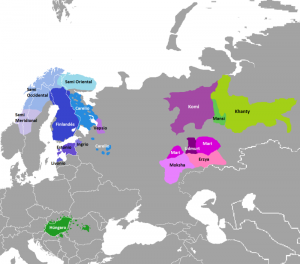
Finno Ugric language distribution
Hungarian is one language within the Finno-Ugric Language Family. An Asiatic language, it is similar to Chinese and Korean in that the surname comes first and a person’s given name comes second. The major and western-most languages in the group are of course Hungarian, Finnish, Estonian, and Sami (the language of the “Lapplanders”). When I ask my Hungarian friends what Finnish sounds like to them, they universally tell me that “it sounds like it’s supposed to make sense, but it doesn’t.” Conversely my Finnish friends say the same thing of Hungarian.
Many given names are the same or similar between Hungarian and Finnish: Ildiko is a female name in both languages; the Finnish equivalent of Attila is Antilla.
 So picking up where Szilard and Fermi left off, it occurred to me that Jabba the Hutt is very similar to the Hungarian name Csaba (pronounced “chubba”) and Hutt is strikingly similar to Hun, as in Attila the Hun. It makes perfect sense that the Huns, who became the Hungarians or the Magyar tribe, are descendants of Hutts who somehow made it to Earth. No doubt they fled in terror after Princess Leia despicably strangled Jabba the Hutt to death.


You must log in to post a comment.