
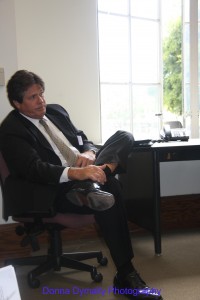
Lobbyist Gregory J. Spicer at 8-27-13 meeting of the Office of Finance
Yesterday, August 27, 2013, at an apparently private meeting called by the Los Angeles City Office of Finance (OOF) that was in fact advertised only to clients of registered lobbying firm Ken Spiker & Associates and which only became known to non-clients in the parking industry through a whistle blower/leaker, Assistant Director of the OOF Ed Cabrera expressly stated that if I asked any questions he would refuse to answer them and forbade my photographer, Donna Dymally, from continuing to take photos. Attorney Roger Jon Diamond pointed out to Ed Cabrera that this practice was more conducive to government in Pyongyang, North Korea than in the so-called free society we are supposed to enjoy in Los Angeles. Cabrera also refused to state whether or not the meeting was subject to the Brown Open Meeting Act…..

L to R: Cynthia Conover, Patricia Nazario, Jan B. Tucker, Renata Sdao, Eric M. Garcetti, Dele Ailemen, Linda Pruett, Sherry Lear
Eric Garcetti, who I endorsed in the Mayoral election along with the Same Page/Misma Pagina Coalition organizations I participate in, promised transparency and accountability in city government. I wait with baited breath to see what he has to say about a city department carrying on private meetings to which only the clients of a lobbying firm are invited and which other business people who are not clients of the lobbyist have to crash into like a private party. This “party” was so private that it was held in room 152b at City Hall, a room without functioning air conditioning and without enough seating. They had to open the windows which in turn caused people in the back to be unable to hear the speakers (they had no microphones or P.A. system) due to the traffic noise from Spring Street. Of course, since the Office of Finance selected an auditing firm for parking lot tax audits that was itself a tax scofflaw (suspended by tax authorities in its home state of Texas and in Florida and which conveniently didn’t bother to register with tax authorities or government agencies in California) I don’t have any confidence in the Office of Finance to even organize a meeting properly…..
Below is my first salvo to breathe some transparency into the lungs of Los Angeles democracy:
August 28, 2013
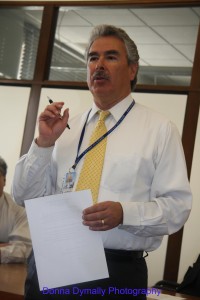
Ed Cabrera, Assistant Director, Los Angeles City Office of Finance
Ed Cabrera, Assistant Director Office of Finance City of Los Angeles 200 N Spring Street Rm. 201 Los Angeles CA 90012
Dear Mr. Cabrera:
The following request is made pursuant to the California Public Records Act and the decisions in KNSD Channels 7/39 v. Superior Court (Vasquez) (1998) 63 Cal.App.4th 1200, 74 Cal.Rptr.2d 595 [No. D029949. Fourth Dist., Div. One. May 13, 1998.], Copley Press, Inc. v. Superior Court (M.P.R.) (1998) 63 Cal.App.4th 367, 74 Cal.Rptr.2d 69 [No. D029986. Fourth Dist., Div. One. Apr 20, 1998.], and Copley Press, Inc. v. Superior Court (Adams) (1992) 6 Cal.App.4th 106, 7 Cal.Rptr.2d 841 [No. D016546. Fourth Dist., Div. One. May 7, 1992.] which govern the common law and constitutional right to public access to government and judicial records. As to any judicial records I am seeking, the legislature enacted Section 77206(f) of the Government Code to require judicial rules must “ensur[e] [120 Cal.App.4th 293] that, upon written request, the trial courts provide, in a timely manner, information relating to the administration of the courts, including financial information and other information that affects the wages, hours, and working conditions of trial court employees.” (§ 77206, subd. (f).) as held in Orange County Employees Assn., Inc. v. Superior Court (2004) 120 Cal.App.4th 287, 15 CR 3rd 201.
These laws and decisions preceded the enactment of SCA 1 (Proposition 59) which was passed overwhelmingly by the voters in November 2004. SCA 1 amended Article I, Section 3 of the California Constitution by providing that “The people have the right of access to information concerning the conduct of the people’s business, and, therefore, the meetings of public bodies and the writings of public officials and agencies shall be open to public scrutiny” and that ”A statute, court rule, or other authority, including those in effect on the effective date of this subdivision, shall be broadly construed if it furthers the people’s right of access, and narrowly construed if it limits the right of access.”
In the case of Sutter’s Place Inc. v. Superior Court (City of San Jose) (2008) 161 Cal.App.4th 1370, 75 CR 3rd 9, the court held that “”Implicit in the democratic process is the notion that government should be accountable for its actions. In order to verify accountability, individuals must have access to government files. Such access permits checks against the arbitrary exercise of official power and secrecy in the political process” (CBS, Inc. v. Block (1986) 42 Cal.3d 646, 651.) and that:
The California Public Records Act (CPRA) (Gov. Code, § 6250 et seq.), enacted by the Legislature in 1968, provides for this access via a scheme to inspect public records maintained by state and local agencies. (Gilbert v. City of San Jose (2003) 114 Cal.App.4th 606, 610.) The CPRA replaced a hodgepodge of statutes and court decisions relating to disclosure of public records and was conceived broadly to require full agency disclosure unless information is statutorily exempted. (Los Angeles Unified School Dist. v. Superior Court (2007) 151 Cal.App.4th 759, 765 (Los Angeles Unified).)
“With the passage of Proposition 59 effective November 3, 2004, the people’s right of access to information in public settings now has state constitutional stature, grounding the presumption of openness in civil court proceedings with state constitutional roots.” (Savaglio v. Wal-Mart Stores, Inc. (2007) 149 Cal.App.4th 588, 597 (Savaglio); see also Commission on Peace Officer Standards and Training v. Superior Court (2007) 2007 DJDAR 13089, 13090 [ "As a result of an initiative measure adopted by the voters in 2004, this principle now is enshrined in the state Constitution"] (Commission); International Federation of Professional and Technical Engineers v. Superior Court (2007) 2007 DJDAR 13105, 13106 [same] (International Federation); BRV, Inc. v. Superior Court (2006) 143 Cal.App.4th 742, 750 [Proposition 59 "enshrined in our state Constitution the public's right to access records of public agencies"] (BRV); Los Angeles Unified, supra, 151 Cal.App.4th at p. 765 [same].)
Vallejos v. California Highway Patrol (1979) 89 Cal.App.3d 781, 152 Cal.Rptr. 846 held after initial periods of confidentiality, some records ultimately become public records:
“The filing of a document imports that it is thereby placed in the custody of a public official to be preserved by him for public use. Because for a season its value is best conserved by maintaining its confidential character by excluding public gaze, it becomes no less a public record. (People v. Tomalty, 14 Cal.App. 224, 232 [111 P. 513]; Cox v. Tyrone Power Enterprises, Inc., 49 Cal.App.2d 383, 395 [121 P.2d 829].) (People v. Pearson (1952) 111 Cal.App.2d 9, 30 [244 P.2d 35].)
Therefore, if you contend that any record I am seeking is temporarily but not permanently unavailable, please identify the precise or approximate date when you believe that this record will or may become publicly available and/or the circumstances which must exist for it to become publicly available.
In the event that you intend to object to release of these records because you believe that the request is somehow related to litigation, unless the records requested were expressly prepared for counsel, attorney-client privilege does not apply. Additionally, the fact that litigation exists or might come into play is fundamentally irrelevant to the California Public Records Act. See City of Hemet v. Superior Court (Press-Enterprise Co.) (1995) 37 Cal.App.4th 1411, 44 Cal.Rptr.2d 532.
Context Upon Which This Request is Based
On August 27, 2013 you (Ed Cabrera) conducted a meeting in Room 152b of Los Angeles City Hall at which you made the following representations:
-
The meeting was an “attempt to provide education and outreach;”
-
You made a reference to “each operator registered with the Office of Finance” in connection with parking lot ownership or operation;
-
The Office of Finance did “outreach” to parking lot operators to invite them to the August 27, 2013 meeting;
-
That people employed by the City of Los Angeles would “lose their jobs” if they disclosed confidential information as defined in the Municipal Code and California law (and while you did not specifically specify, I am presuming that you were referring to violations of the California Information Practices Act) and that the City of Los Angeles takes confidentiality rules “very seriously;”
-
That “administration of tax should be fair and consistent across the board” referring to Parking Occupancy Taxes (POT);
-
That you and/or the Office of Finance went through Gregory J. “Greg” Spiker of KSA, a firm which represents the Parking Association of California and the Los Angeles Parking Association as a lobbyist registered with the City Ethics Commission for purposes of inviting people to the August 27th meeting;
-
That you indicated to the attendees that “Greg [Gregory J. Spiker] and I will have an ongoing dialogue” concerning issues raised at the meeting by attendees [regardless of whether they were or were not clients of Spiker or members of organizations he represents as a lobbyist];
-
That the efforts of the Office of Finance concerning formulation and implementation of the POT surety bonding requirement are intended to create a “level playing field” for all operators and that to justify this statement you used the example of the difference between an honest operator and an operator who was pocketing 50% of cash revenue;
-
That you stated “I don’t know many of you. You’re here because you want to get it right;”
-
That you told a person at the meeting asking a question “I would prefer that you run them [questions] through Greg;”
-
That you stated “After Greg and I discuss it we can come to some agreement;”
-
That you stated “I’d like to thank Greg for reaching out to you;”
-
That you repeatedly spoke the word spelled “surety” without dissolving the “s” and the “u” into a “shu” as though it was a vowel diphthong even after hearing Bradley Moe and others pronounce the word correctly;
I am therefore requesting copies of all writings as defined in California Government Code Section 6252(f) and California Evidence Code Section 250, constituting:
-
All writings including but not limited to emails, memos, letters, and other communications demonstrating that the Office of Finance did not limit its “outreach” efforts for the August 27, 2013 meeting to clients or members of clients of Ken Spiker & Associates, Inc.;
-
All rules, regulations, guidelines, policies and procedures concerning whether Los Angeles City employees are allowed to give preferential treatment to clients of lobbyists registered with the City Ethics Commission;
-
All writings including but not limited to emails, memos, letters, and other communications demonstrating that the Office of Finance did not limit its “outreach” efforts for anything related to the POT in connection with the inquiries of the Commission on Revenue Enhancement (CORE) to clients or members of clients of Ken Spiker & Associates, Inc.;
-
All writings including but not limited to emails, memos, letters, and other communications demonstrating that the Office of Finance did not limit its “outreach” efforts for formulation of Ordinance No. 182283 to clients or members of clients of Ken Spiker & Associates, Inc.;
-
All writings demonstrating that any employee of the City of Los Angeles has ever lost their job after violating the Information Practices Act and/or any city information confidentiality ordinance1;
-
All writings demonstrating any planning to provide equal educational and or informative opportunities to parking lot operators who are not clients of KSA so that the POT tax and bonding requirements are administered on a level playing field;
-
All writings including but not limited to notes, memorandums, emails, letters or other communications documenting and/or referencing every communication the Office of Finance has engaged in with KSA and/or any employee or agent of KSA concerning POT within the preceding five (5) year period;
-
A copy of the attendance sheet for the August 27, 2013 meeting.
Under Section 6253 of the Government Code you have ten (10) days to comply with this request.
If you believe that I am not entitled to the records I am requesting, you must justify your refusal within (ten) 10 days in writing under Section 6255 of the Government Code. You may only refuse to give me these records if there is an express law prohibiting you from giving them to me. In the case of California State University, Fresno Assn., Inc. v. Superior Court (McClatchy Co.) (2001) 90 Cal.App.4th 810, 108 Cal.Rptr.2d 870 [No. F037383. Fifth Dist. Jul. 16, 2001.] the court held that “The burden of proof is on the proponent of nondisclosure, who must demonstrate a ‘clear overbalance’ on the side of confidentiality. [Citations.] The purpose of the requesting party in seeking disclosure cannot be considered…. It is also irrelevant that the requesting party is a newspaper or other form of media, because it is well established that the media has no greater right of access to public records than the general public….”
This letter constitutes a formal demand to maintain evidence as it currently exists. If you destroy, lose, misplace, damage or otherwise make these items unavailable prior to the time that a court order or subpoena duces tecum can be obtained, you may be subject to a variety of sanctions (see Willard vs. Caterpillar, Inc. [1995] 40 Cal.App.4th 892. Williams v. Russ (2008) 167 Cal.App.4th 1215 held that:
Spoliation of evidence means the destruction or significant alteration of evidence or the failure to preserve evidence for another’s use in pending or future litigation. (Willard v. Caterpillar, Inc. (1995) 40 Cal.App.4th 892, 907, overruled on other grounds in Cedars-Sinai Medical Center v. Superior Court (1998) 18 Cal.4th 1, 18, fn. 4 (Cedars-Sinai.).) Such conduct is condemned because it “can destroy fairness and justice, for it increases the risk of an erroneous decision on the merits of the underlying cause of action. Destroying evidence can also increase the costs of litigation as parties attempt to reconstruct the destroyed evidence or to develop other evidence, which may be less accessible, less persuasive, or both.” (Cedars-Sinai, supra, at p. 8.) While there is no tort cause of action for the intentional destruction of evidence after litigation has commenced, it is a misuse of the discovery process that is subject to a broad range of punishment, including monetary, issue, evidentiary, and terminating sanctions. (Code Civ. Proc., §§ 2023.010, subd. (d), 2023.030, subds. (a)-(d); Cedars-Sinai , at p. 12.) A terminating sanction is appropriate in the first instance without a violation of prior court orders in egregious cases of intentional spoliation of evidence. (R.S. Creative, Inc. v. Creative Cotton, Ltd. (1999) 75 Cal.App.4th 486, 497.)
Such behavior may also be criminal, under California Penal Code Section 135, which states:
Every person who, knowing that any book, paper, record, instrument in writing, or other matter or thing, is about to be produced in evidence upon any trial, inquiry, or investigation whatever, authorized by law, willfully destroys or conceals the same, with intent thereby to prevent it from being produced, is guilty of a misdemeanor.
If any data is maintained in digital format, I strongly advise you to hire a forensic computer examiner who is qualified to clone any hard drive on which the data I am requesting currently exists if you do not intend to produce it without a court order, so that the data will be preserved intact and in an admissible format.
If you fail to comply with this request, I have a legal right to bring suit to force you to comply under Section 6259 of the Government Code and if I prevail, it is mandatory that the court award me reasonable attorney fees and costs.
Respectfully Yours, Jan B. Tucker
cc: Eric M. Garcetti, Mayor; Ana Guerrero, Mayoral COS; Ron Galperin, City Controller; Mike Feuer, City Attorney; Roger Jon Diamond, Esq.; Steven M. Finger, Editor/Publisher Los Angeles Free Press; Jeffrey St. Clair, Editor/Publisher CounterPunch Magazine; parking lot operators.
1Just for your edification it is perfectly possible for a neo-Nazi employed by the City of Los Angeles to get caught violating the Information Practices Act by providing my home address from DMV data bases to the White Aryan Resistance and the Ku Klux Klan and be rewarded for his behavior. He received a 14 day suspension and was subsequently promoted to LAPD division adjutant.

