
Guest Opinion, by Sherry Lear, Esq. & a leader of Miss Revolutionaries
Like many others, I was absolutely shocked to find out that Steve Landsburg had published a blog which posed the question:
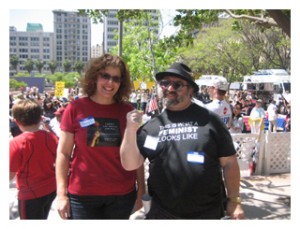
Sherry Lear (L), Jan B. Tucker (R) @ Miss Revolutionaries rally
“Let’s suppose that you, or I, or someone you love, or someone we care about from afar, is raped while unconscious in a way that causes no direct physical harm– no injury, no pregnancy, no disease transmission. (Note: The Steubenville rape victim, according to all the accounts I’ve read, was not even aware that she’d been sexually assaulted, until she learned about it from the Internet some days later.) Despite the lack of physical damage, we are shocked, appalled and horrified at the thought of being treated in this way, and suffer deep trauma as a result. Ought the law discourage such acts of rape? Should they be illegal?”
(For those who missed the original, it has been edited as of 4/5/2013, but the basic content is the same: http://www.thebigquestions.com/2013/03/20/censorship-environmentalism-and-steubenville/.)
Of note, this is the Third Question posed in the blog. The first two also present hypothetical questions about two individuals, notably each of those is given a name. The rape victim is not given a name, she is only identified as a female and presumed to be someone that the reader loves or cares about. From the moment of identification, the rape victim – and she would be considered a rape victim in any state in this Country as having sex with someone who is incapable of consent is the very definition of rape — is treated differently. She has no name but she is only considered to be worthy of consideration if she has a relationship to the reader – the very least of which is being someone that the reader must care about “from afar.”
What about the rape victim who fits this scenario but is NOT someone that the reader, or even society in general, cares about? What if the victim happened to be an unconscious child, of such a tender age that the child did not and could not appreciate that she (or he – please remember that 10% of male children in the United States are the victims of sexual abuse) had been violated? What about the drug addict or alcoholic homeless woman who has passed out lying in an alley who is raped? What about the woman, that someone else loves or cares about, but that the reader does not know? What about a woman (or man) who has been intentionally drugged so as to facilitate the act of rape? Are these victims not worthy of consideration? Why has such a limitation been placed that the victim must be someone of value to the reader? What does that say about society in general or the person posing the question?
The author of this piece has, it seems intentionally, asked the reader to assume an emotional connection with the victim. Notably, the presumed emotional connection is not designed or intended to show support for the victim; but rather, to point out what author sees as a flaw in logic by virtue of the reader’s reaction to the proposed scenario, as opposed to those proposed in Questions One and Two.
In Question One, Farnsworth McCrankypants suffers “deep psychic distress” from the mere idea of someone viewing pornography, even though McCrankypanks does not believe that pornography causes bad behavior. Landsburg asks if Farnsworth “preferences” are to be considered when making public policy relating to pornography or used as an argument for discouraging pornography through taxation or regulation. Landsburg’s opinion about this is obvious from the title to the article which references this as “censorship.”
In Question Two, Granola McMustardseed, a female, suffers from psychic distress at the idea of altering the natural state of a wilderness area. Landsburg asks if the psychic harm suffered by Granola should be considered, for example, as a reason to discourage oil drilling in in Alaska even if she has no plans to visit that area or “derive any other direct benefits from it.” Again, the title to this article gives us a clue to Landsburg attitude about Granola since he sums up such concerns as “environmentalism.”
The MetaQuestion then posed is what is the critical difference between Questions 1, 2and 3 if the answers to these questions are not all the same.
There are many issues which could be addressed. I will only attempt to tackle a few. First, is the hypotheticals themselves. As I have already noted, both of the “victims” in Questions One and Two are given names. Those names, standing alone, carry certain judgments about person being discussed. One can imagine an elderly, White, Christian male of conservative values and political affiliations as “McCrankypants.” The very name makes Farnsworth an unreasonable person. Granola, on the other hand, conjures up images of an “environmentalist” – read tree-hugging hippy-type — who is equally unreasonable. While all three questions are posed as hypotheticals, Questions 1 and 2 carrying enough stereotypical images that the reader can create an image of a person – one that the reader may likely already have some preconceived biases(either positive or negative) about.
Going back to Question One – Farnsworth is painted as unreasonable by virtue of the fact he hates the mere idea of people looking at pornography but has no concern about or belief that pornography causes bad behavior. The question does not even assume that Farnsworth has a religious or moral objection to pornography – he just does not like the mere “idea” of someone viewing pornography – even if he does not see that act or never sees the pornography himself. Thinking more deeply, does a person like Farnsworth actually exist? Most who would regulate or “censor” pornography (a word which in itself carries negative judgments) – even the stereotypical elderly, White, Christian male with conservative political leanings – are able to articulate some rational for doing so. Farnsworth is not afforded such an opportunity. Why is this? With the scenario described, Farnsworth is actually someone who does not exist. Thus, his“preferences” would never bear on public policy or legislation.
On to Question Two – the hypothetical again lacks critical details. When Landsburg uses the term “a wilderness area,” what does this refer to? Wilderness in terms of undeveloped, virgin land? Who owns this wilderness? Has it been designated as “wilderness” by the United States Government (a designation which carries very specific meaning and protections) or some other country? Is there anything unique to this wilderness – be it in the flora, fauna, history or the location itself? How much flora and fauna does this wilderness area support and will the alteration of the wilderness area have a negative effect on these life forms? Moreover, are there humans (since Landsburg seems to assume that human needs are all that matter) who are presently deriving some sort of “benefit” from the wilderness in question besides Granola? Question Two also overlooks the fact that Granola may derive some benefit without visiting the wilderness –such as enjoying photographs of it or even some sort of natural product (think organic honey) that may be gathered there.
Unlike Farnsworth, Granola can be a real person. There are many people (some who may call themselves environmentalists and others who may not) who find the idea that virgin wilderness, undisturbed by humankind, has a value in and of itself. Why is Landsburg so quick to dismiss this? Landsburg then moves on to ask the question if Granola’s concerns (which are initially described as for “a wilderness area”) should be considered when deciding to drill for oil in Alaska. Well, there are parts of Alaska that are designated as wilderness and parts that are not. That wilderness also has some unique values in and of itself – such as supporting species of endangered animals, containing important layers of permafrost, etc. etc. But, Landsburg’s blog minimizes the entire environmental movement by claiming that the concerns of a person with no plans to visit a wilderness area being proposed for oil drilling should not be considered when making public policy. Granola concerns are not invalid, nor is a concern for preserving wilderness overall one that should be invalidated.
In contrast,the Third Question is far from a hypothetical. It is a direct correlation to an actual rape scenario, one which has garnered national attention, response and, rightly, outrage. The Steubenville victim is not a stereotype but a real person. Moreover, she is one of hundreds of thousands of rape victims in the United States. She is a victim of an acquaintance rape –having been raped by someone that she knows – and not a stranger rape. She was intoxicated at the time of her rape,which is also a common scenario for many rape victims. She is not merely sitting in her home and suffering from psychic distress as the thought of what someone else might be doing in a place far, far away, as part of an act which she herself will never witness. Moreover, we have all also witnessed this act by virtue of the publication of photographs showing her unconscious and naked body being dragged about in a room full of partygoers. We not only know that this woman was violated, but we have seen it displayed – across the Internet - - where she has been violated all over again.
Landsburg is troubled by the fact he can find no reason for the victim (or the reader) to be upset by finding out about a rape which occurred when “safely unconscious” and therefore, “shielded from the costs of an assault.” Clearly, the Steubenville victim was not “safe”when she passed out intoxicated and was dragged around a party by a rape crew,photographed and left violated. Clearly, she was not shielded from the “costs” of an assault. There are many, many rape victims – intoxicated or not – who pass out or black out during the act and are unable to remember all, part or much of it. This is quite common as the brain, once it perceives that the assault cannot be prevented, will go into a crisis reaction mode. The normal human reaction of fight having been overcome by the perpetrator will turn to flight – which might be that therape victim’s subconscious blocks memory of the attack. But such “relief” may be only temporary. Many, many victims of rape block these events from memory for months and even years, only to have some trigger bring the event back to memory and, along with it, very real psychological trauma.
Landsburg clearly knows little, if anything, about the realities of rape, the psychological effects on the victim or the reactions of rape survivors. His comment that rape can ever cause merely “psychic harm” shows he has little understanding of the female anatomy. Having a foreign object penetrate a vagina that is unprepared for such penetration and without consent is, by definition, a physical harm. There are many physical changes which need to occur in a women’s body to ready it for sex, for example, increased blood flow to the sexual organ area, swelling, the loosening of vaginal and cervical muscles and creation of lubrication to allow the object to move into the vagina without discomfort or damage.
Rape in and of itself is a physical damage. To equate being raped with being penetrated by photons (light particles) from a street lamp is an extremely poor analogy and even more dismissive than Landsburg’s attitude toward environmentalists who want to save wilderness areas from desecration.
 Sex is the most personal of contact that any two human beings can have. It can, and must, require consent. A sexual penetration achieved without full, willing and knowledgeable consent of both parties is a rape. If we allow someone to “reap the benefits” of such a penetration without consent, or even consider the idea of legalizing such action if the perpetrator takes efforts to make sure the victim does not remember the assault, then what are we condoning? It must involve some act to render the rape victim unconscious; an act which would, again, be done without consent. Would that involve physically knocking the victim out, administering drugs, hypnosis? If a would-be rapist comes upon a person who is unconscious for whatever reason (asleep, ill, comatose, intoxicated)how would the rapist be able to ensure the victim would not wake up during the attack? Drugs? Chloroform? What if the drugs administered themselves cause a physical harm (separate from the penetration itself.) Would that be a crime while the rape is not?
If we, as a society, were to allow sexual penetration to occur in such a circumstance, what would we teach our children about this? Little Johnny or Jane, I want you to know that if you get drunk and pass out at a party, or you happen to be in a deep sleep, then someone is allowed to sexually penetrate you as long as you don’t know about it. And, it really is not a big deal since that person has not really “harmed” you. What parent is going to have this conversation with a child? None that I can imagine in any hypothetical.

Steven Landsburg, male chauvinist pig (MCP)
On to Landsburg’s scenario, how can the rapist ensure that the act of penetration,done without consent on an unconscious victim won’t cause harm? A vagina can suffer tearing from consensual sex. What if the victim is a virgin and her hymen is torn during the act? Is that not a harm? How do we really know that the victim will not experience pain during the attack? As noted before, what if the memory of the incident and the pain come back months or years later? Can the perpetrator be prosecuted at that time? And who is the one to decide if the victim has suffered physical “harm.” Is it enough that the victim say something like, “I was passed out and I don’t remember the act, but I had spotting afterward or my vagina felt sore.” Who is to make such a judgment as to whether the “harm” was physical or “enough” to merit prosecution? What about a victim who suffers from PTSD (as many victims of sexual assault do?) Is this a physical harm? The questions are endless and so are the potential problems that allowing anyone to “reap the benefits” of non-consensual sex under any circumstance.
Is Landsburg actually serious when he proposes the idea that rape of an unconscious person be legalized if the perpetrator takes precautions “to ensure the victim never learns about it?” And why limit the scenario to sexual assault? What about the homeowner who leaves his home unlocked while away at work? Is there any physical harm, if a passerby enters the home and makes herself comfortable while the owner is gone? After all, the homeowner is not being deprived of the use of the home himself and so long as nothing is disturbed or removed, the homeowner will never know. So, why not let the passerby “reap the benefits?”
Which leads me to my last thought for this response. No one should ever “reap the benefits” of a sexual assault. There is no benefit for anyone in a rape. It is a dehumanizing and animal act, not just for the victim but also for the perpetrator. The very thought of legalizing rape, in any form or any circumstance, is not something which merits “critical thought.” It appropriatelymerits disgust and revulsion. And, I for one, am disgusted that someone who holds the position of professor at an institute of higher education would ever suggest this.
_____________
My commentary: Sherry has been careful and proper to avoid argumentum ad hominem (abuvise) terminology to refer to Landsburg. Normally, I am careful to do so as well, but in this case, I can’t refrain. He is either an idiot, an asshole, a male chauvinist pig (MCP) or some combination of the foregoing.


You must log in to post a comment.