

Demonstration to free the “Hollywood 10″
Two things happened this week which by coincidence or fate brought back a flood of memories and emotions about my father, Saul Selwyn Tucker. First, the son of the Hollywood Reporter‘s founder apologized for that paper’s role in blacklisting. Three days later I received two emails that left me simultaneously proud and humbled. Jeffrey St. Clair of Counter Punch [http://www.counterpunch.org/] invited me to become that magazine’s Criminal Justice Columnist and Scotty Reid of Black Talk Radio [http://blacktalkradionetwork.com/] asked me to become a regular commentator on his program. As to the Hollywood Reporter’s belated discussion of their issue, Associated Press reported:
SANDY COHEN | November 19, 2012 07:51 PM EST | AP
LOS ANGELES — The son of The Hollywood Reporter founder Billy Wilkerson is apologizing for his father’s and the trade paper’s role in the 1947 Hollywood Blacklist that destroyed the careers of writers, actors and directors accused of having communist ties.
In an article published Monday by The Hollywood Reporter, Willie Wilkerson, 61, calls the Blacklist era “Hollywood’s Holocaust” and says, “On the eve of this dark 65th anniversary, I feel an apology is necessary.”
He says his father supported the Blacklist to exact revenge against the Hollywood titans he felt denied him entry to their club when he wanted to establish a movie studio in the late 1920s. Billy Wilkerson founded The Hollywood Reporter in 1930, and after World War II, used the paper as a vehicle for a series of editorials attacking communist sympathizers and their influence in Hollywood.
“In his maniacal quest to annihilate the studio owners, he realized that the most effective retaliation was to destroy their talent,” Willie Wilkerson writes. “In the wake of this emerging hysteria surrounding communism, the easiest way to crush the studio owners was to simply call their actors, writers and directors communists. Unfortunately, they would become the collateral damage of history. Apart from being charged with contempt, for refusing to name names, none of these individuals committed any crimes.”
One serious mis-perception created in large part by Hollywood itself about blacklisting is that it only happened to entertainment industry people and/or journalists (as in 1991′s Guilty by Suspicion or The Front in 1976). I have one friend who’s father was a janitor and it happened to him. My father was a millwright-machinist and likewise he was fired from government service, harassed by the FBI when he got private sector employment, and his nascent writing career came to an abrupt halt.

Civic Unity groups around the United States in the late 40s sprouted up to demand that America live up to the ideals Americans had fought for in World War II, right here at home.
My dad had a heart murmur from childhood rheumatic fever and so was rejected when he tried to enlist in all the armed services, so to do his part he got a civilian job with the Army Air Corps at Hickam Field in Hawaii as a millwright-machinist. Working class, progressive, and militantly against discrimination, as I would later find out from his FBI and U.S. Army intelligence files and from his own anecdotes, he spent his spare time helping to organize pineapple workers for the International Longshore & Warehouse Union (ILWU which launched a Hawaii sugar strike in 1946), participating in an integrated recreational organization (I know that from watching home movies) known as the Hawaii Trail & Mountain Club, attending a meeting of the United Public Workers of America (UPWA-CIO) to hear Abraham Flaxer speak, and becoming an activist with the Hawaii Association of Civic Unity (HACU). The Civic Unity associations around the United States were dedicated to ending discrimination of all sorts and were well ahead of their time. It was pointed out in the context of explaining why the organization was (to the writer, Army Col. Innes Randolph) obviously Communist because HACU’s constitution called for:
- Ending discrimination based on race, creed, color, sex, national origin, and political belief
- Equality of opportunity on the same criteria
- Better standards of living and social progress for all
- Promoting better understanding and unity amongst people of various racial and ethnic backgrounds.
Horrors! My liberal and conservative friends see this and are aghast, usually opining something along the lines of “but I thought that was what America was all about.” In my father’s case it got him fired from his job.
Consider the context: this was 1946 -47 and it was still well before the Henry Wallace Progressive Party presidential campaign forced Harry Truman to order the desegregation of the armed forces on the basis of race. Not to mention, calling for an end to sex discrimination wouldn’t even be considered a responsible, reasonable, or even sane demand by liberals (let alone everybody else) until the feminist revolution of the 60s. It was only radicals like my dad who dared propose and fight for these ideals in the 40s and they paid a dear price for their activism.
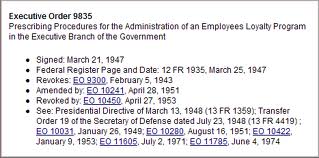 President Truman signed Executive Order 9835, the so-called “Loyalty Order,” on March 21, 1947. This was well before Joe McCarthy had started his rampage against civil liberties in America. Under the Loyalty Order, around 3,000,000 federal employees were subjected to witch hunt type investigations. Around 5,000 simply quit. Only about 3-400 contested their firings. My father was one of them. Another was the EEO officer of the Roosevelt administration who’d pushed to create the unit that became known as the Tuskegee Airmen (his name escapes me). I met his son at a Tuskegee Airmen L.A. Chapter event in January 2009. Like my dad, his father was subjected to a worse than Kafkaesque proceeding (Kafka’s “The Trial” might have been bizarre, but at least the victim was allowed to attend his own trial; under 9835 proceedings you had no right to know who the witnesses were or what the evidence against you encompassed).
The reason I now know what the evidence that was used against my father is because I got it eight years after he died under the Privacy Act, 5 USC 552a, which didn’t exist when he was facing his persecution. In addition to his having attended the UPWA meeting and his activism with HACU, his being Vice President of the Hawaii Trail & Mountain Club was also used against him. Seriously, I couldn’t make this up if I tried.

My father was fired and blacklisted for being Vice President of the Hawaii Trail & Mountain Club, a racially integrated organization
According to a report by the 401st Counter Intelligence Corps (CIC) of the Navy, which had an informant in the club, at the meetings, “Tucker never said anything good about the United States and never said anything bad about Russia.“ One might think that the “confrontation clause” of the United States Constitution would mean that my father had a right to confront (Sixth Amendment) his accuser about this statement but he never even knew it was evidence used against him in these secret proceedings. One might also think that under normal rules of evidence in a nation that prides itself on “due process of law” (Fifth Amendment) evidence of what somebody did NOT say would be inadmissible. In fact, it should have been considered to be ridiculous, but in 1947 it was a statement in the record used to fire my father.
There is also this little problem of the right to counsel in these proceedings, especially in Hawaii. My father, and many like him in Hawaii, were defended by Harriet Bouslog.
Harriet Bouslog had a truly extraordinary life and career in an era when it was rare and almost impossible for a woman to become a lawyer. For a biographical work, see http://www.hawaii.edu/biograph/biohi/bouslogguide.pdf. As the Honolulu Advertiser wrote:
From the outset of her legal career Harriet Bouslog relished her role as the champion of the underrepresented in the community. Long before the advent of the Legal Aid Corporation and the Office of the Public Defender, she chose to offer her legal services to clients at the bottom of the socioeconomic scale.
And for the record, she never turned away a client or a cause because of a lack of funds.
She certainly didn’t turn away my father. A longstanding principle of the legal profession is [as enshrined for example in California Business & Professions Code Section 6068(h)] the concept for an attorney to “Never to reject, for any consideration personal to himself or herself, the cause of the defenseless or the oppressed.” For her efforts of defending the poor and the unfortunate she too came under attack by the system, disbarred by the Hawaii Territorial Supreme Court. She had to appeal all the way to the U.S. Supreme Court to get her suspension overturned on a narrow 5-4 vote. Ostensibly, Bouslog’s right to practice law was suspended on a complaint from the Hawaii Bar Association because of a speech she gave to ILWU members regarding her defense of their members who were accused of illegally being members of the Communist Party. In In re Sawyer - 360 U.S. 622 (1959) [Sawyer was Bouslog's married name], Justice William J. Brennan Jr. wrote for the majority that:
Petitioner’s clients included labor unions, among them the International Longshoremen’s and Warehousemen’s Union. Some of the defendants in the Smith Act trial were officers and members of that union and their defense was being supported by the union. The meeting at Honokaa was sponsored by the ILWU and was attended in large part by its members. The petitioner spoke extemporaneously and no transcript or recording was made of her speech. Precisely what she did say is a matter of dispute. Neither the Territorial Supreme Court nor the Court of Appeals saw the witnesses, but both courts, on reading the record, resolved matters of evidentiary conflict in the fashion least favorable to the petitioner. For the purposes of our review here, we may do the same. The version of the petitioner’s speech principally relied upon by the Court of Appeals, 260 F.2d, at 197-198, is derived from notes made by a newspaper reporter, Matsuoka, who attended the meeting and heard what the petitioner said. These were not Matsuoka’s original notes - the originals were lost - but an expanded version prepared by him at the direction of his newspaper superiors after interest in the speech was aroused by Matsuoka’s account of it in the newspaper……The summary will illumine the basis of our conclusion that the finding that the petitioner’s speech impugned the integrity of Judge Wiig or reflected upon his impartiality and fairness in presiding at the Smith Act trial is without support. The fact finding below does not remove this Court’s duty of examining the evidence to see whether it furnishes a rational basis for the characterization put on it by the lower courts. See Fiske v. Kansas, 274 U.S. 380 . Speculation cannot take over where the proofs fail. We conclude that there is no support for any further factual inference than that petitioner was voicing strong criticism of Smith Act cases and the Government’s manner of proving them, and that her references to the happenings at the Honolulu trial were illustrative of this, and not a reflection in any wise upon Judge Wiig personally or his conduct of the trial.
…….
Petitioner said that the Honolulu trial was really an effort to get at the ILWU. She wanted to tell about some “rather shocking and horrible things that go on at the trial.” The defendants, she said, were being tried for reading books written before they were born. Jack Hall, one of the defendants, she said, was on trial because he had read the Communist Manifesto. She spoke of the nature of criminal conspiracy prosecutions, as she saw [360 U.S. 622, 629] them, and charged that when the Government did not have enough evidence “it lumps a number together and says they agreed to do something.” “Conspiracy means to charge a lot of people for agreeing to do something you have never done.” She generally attacked the FBI, saying they spent too much time investigating people’s minds, and next dwelt further on the remoteness of the evidence in the case and the extreme youth of some of the defendants at the time to which the evidence directly related. She said “no one has a memory that good, yet they use this kind of testimony. Why? Because they will do anything and everything necessary to convict.”
……..
We start with the proposition that lawyers are free to criticize the state of the law…..But all are free to express their views on these matters, and no one would say that this sort of criticism constituted an improper attack on the judges who enforced such rules and who presided at the trials. This is so, even though the existence of questionable rules of law might be said in a sense to produce unfair trials. Such criticism simply cannot be equated with an attack on the motivation or the integrity or the competence of the judges. And surely permissible criticism may as well be made to a lay audience as to a professional; oftentimes the law is modified through popular criticism…..
So, by one single vote of the U.S. Supreme Court, Harriet Bouslog was able to continue her career as an attorney…..but many of her clients, without her even having the legal ability to learn what the evidence against them was, were not so lucky. Fired from government service, my dad also lost his budding career as a freelance writer.
 My father had only a high school education. He’d learned his trade as a millwright - machinist with the Works Progress Administration (WPA) at one of their projects in Woodstock, New York (he was always ahead of his time….I guess he was with the original “Woodstock Generation”). He was an avid reader and a brilliant writer. By the age of 24 he’d been published in the Honolulu Star Bulletin and nationally in the Ladies Home Journal. Following his firing and blacklisting the only publication in America that ever accepted his writing again was Compressed Air. Nevertheless, he kept writing and submitting articles without success, only to receive rejection slips. One could read between the lines to recognize when editors were simply afraid to print something with his name on it.
When I was a little boy, my father took me to meet a friend, another blacklisted writer, who’d changed his name to Will B. Heard, in opposition to his blacklisting. So in honor of Will, my dad, and all those like them, call me Will B. Heard II as a pen name.
 So that is why it is both humbling and a source of pride for me to be asked to use my media talents with Counter Punch and Black Talk Radio. I carry with me the burden of keeping true to my father’s ideals and to vindicate his existentialist struggle for, as Hannah Arendt might have characterized it, “species immortality,” or as the Emperor Nezahualcoyotl of Texcoco (Pre-Columbian Nahuatl culture of the Central Valley of Mexico) might have expressed it, his predisposition for “in cuicatl, in xochitl.”
You can help me keep on this fight. If you have on-record story ideas or information to impart that I can help publicize, email it to me at [email protected]. If on the other hand you need to remain as a confidential source under which I will invoke the immunity of California Evidence Code Section 1070 (the journalists’ “Shield Law”), then email it on the record but not for attribution to [email protected].
Venceremos, Jan B. Tucker


Comment from Jose Antonio Franco:
Exquisite.
I just finished reading Barbara Kingsolver’s The Lacuna which includes a lively description of the Inquisition that you and I would been convicted by.
I’m also reminded of my first visit to Spain shortly after the Caudillo’s passing when my dad’s banker warned my father in hushed horrified tones, “Tu hijo…es un Rojo !”